Friday, March 30, 2007


Wednesday, March 28, 2007
Return from Madagascar


Since our last post things in Madagascar only got better (and hotter), and all in all we had a great time. I've posted some pictures above, and will have a Madagascar gallery up soon (the internet here seems a bit wonky right now) on our photo site.
We're now safe and sound back in Kenya and have a week here before we return to Canada. Unfortunately there were 3 Canadian tourists killed in the Nyeri district of Kenya today in a car accident -- something that is way too common here in Kenya. Unfortunately with unsafe roads, even more unsafe lorries, very corrupt police, and a severe lack of highway upkeep, these sorts of things seem destined to continue happening here in Kenya.
We're very excited to get back to Canada, and are continuously debating where we will be eating our first meal when we get back and what things we miss the most back home. Looking forward to seeing the people back in Victoria very soon, and our other Canadian friends and family hopefully soon thereafter!
Tuesday, March 13, 2007
Some New Photos
 |
| 2007 Africa - Spring Misc |
 |
| 2007 Africa - Amboseli |
Hells Gate National Park: In the Dry and in the Wet

After the wet season (February 2007):

Saturday, January 06, 2007
Happy New Years!
The holidays were great, and we had good times with Jenn & Paul on our return to the Aberdares, our trip to Tanzania, and lounging around the house playing cards and drinking holiday concoctions.
In late December we were somewhat annoyed to discover that Housing had made a mistake here at ILRI which would necessitate our moving from the house back into the hostel. We put up quite a fight, but in the end nothing could be done. The guy in charge of Housing felt pretty bad about the whole affair, and ended up hooking us up with the one of the nicest rooms in the hostel. It is much nicer than our previous room here, and in addition to having our own balcony and a queen size bed (we used to have to push two singles together), the room has a killer view:
 It's much brighter than our house was too, so all in all things are pretty good in our new abode.
Things at work for me are going quite well. Without nixing myself for talking about it too much, a team I'm part of has just advanced to the final stage of a competition for a fairly significant governmental grant. We find out in mid-Febuary if we get it, and if we do it'll have a huge impact on what I will be up to for the next 3 years. I'm crossing my fingers...
In other news, we have finally decided where we will be going for our end-of-trip trip (that's not a typo). Here is a big clue:

Can you guess?? Post your answer in the comments if you know...
Saturday, December 30, 2006
Photos from Tanzania
The drive was excellent, and we marveled at how much better the roads are kept in Tanzania in comparison with Kenya. English was spoken less by the locals than in Kenya, but we found the people to be so friendly that it was hardly ever a problem. We had no trouble bringing our vehicle across the border, and were surprised to discover that the usual vehicle fees were waived for us because our stay was less than a week.
Link to pictures below:

Saturday, December 23, 2006
We're back!

The internet was down here at ILRI for a good portion of last week and then we were gone to the Aberdares for the past three days. Because of this we've been incommunicado for quite some time.
Jenn & Paul arrived last Sunday, and we've been enjoying lots of festive activities like board games, bocci ball, and drinking. I wrapped up most of my work early last week, so we decided to head off on a short safari before Christmas to the Aberdares. We'll spend Christmas here, and then we're off to Tanzania on the day after Boxing Day.
Above is a shot of Jess & I from this morning. Our quest for elephant was finally successful, and we had much better luck on this trip than on our previous one to the Aberdares! We should have some video up shortly, and in the meantime here is a link to some stills from the trip:

Sunday, December 10, 2006
Blog Update
Also, comments are now enabled (there were some issues before!), so posting comments shouldn't be an issue anymore. Comment away!
Work has been quite busy lately, so we have no new adventures to talk about. Jessica did a great job of heading up a sexual health workshop for some grade 8 students here which she's posted about below, and we've been getting into the Christmas spirit by decorating the house and listening to Christmas carols! Here are some shots of our lovely advent calendars, as made by Jessica (click to enlarge):


Tuesday, December 05, 2006
Story from the Aberdares!
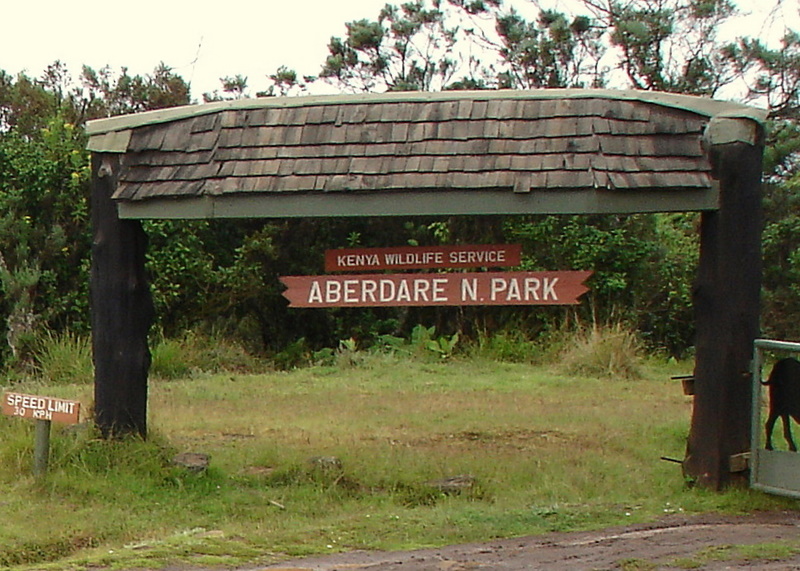
The Aberdares was an adventure unlike any that Jessica & I have been on before. There were highs and there were lows, and in the end we certainly felt strengthened -- and at the same time slightly exhausted -- by the experience. Here is an account of an adventure that we will no doubt recall for years to come, for better or for worse!
DAY 1 - The High Plateau
Aberdare National Park is made up of two distinct sections: moorland, peaks and forest atop a high plateau, and an outcrop of dense rainforest known as the Salient. The park intrigued us for this reason, but also because it would be a good place to find elephants, a species which Jessica still has yet to see in the wild. We decided to approach the park from the Rift Valley to the west, and enter the park via its western entrance. This route would take us straight into the high plateau.
We were to visit the park just at the end of
 the 'short rain' season here in Kenya. This was a slight concern because several of the roads in the Aberdares shut down when things get really wet due to the muddy conditions and mudslides. As we approached the western entrance there was a slight drizzle, but fortunately it wasn't the torrential downpours that we've been experiencing quite frequently these days. As we departed the Rift Valley we were soon able to make out the tall peaks that make up the Aberdare mountain range; four of the tallest of which range from 3500m to 4000m. Rising from foothills to the park gate we found that the road turned into a beautiful paved mountain pass. With each 100 meters we gained in altitude the temperature seemed to drop a degree or so. Soon we reached the gate to the park, paid our park fees to the warden, and also picked up the recommended park map which is only available at the park entrances.
The temperature was colder than anything we've experienced in Kenya so far, and looking at my altimeter I noticed that we were way up at 3200 meters. I remembered being at this height at the basecamp on Mt. Ranier, and know first hand that it is certainly high enough to start feeling the effects of high altitude. The flora at this height was much different than anything we've previously encountered. We made our way to our camp first since it was around 4pm and we wanted to set things up in order to get a quick game drive in before sundown.
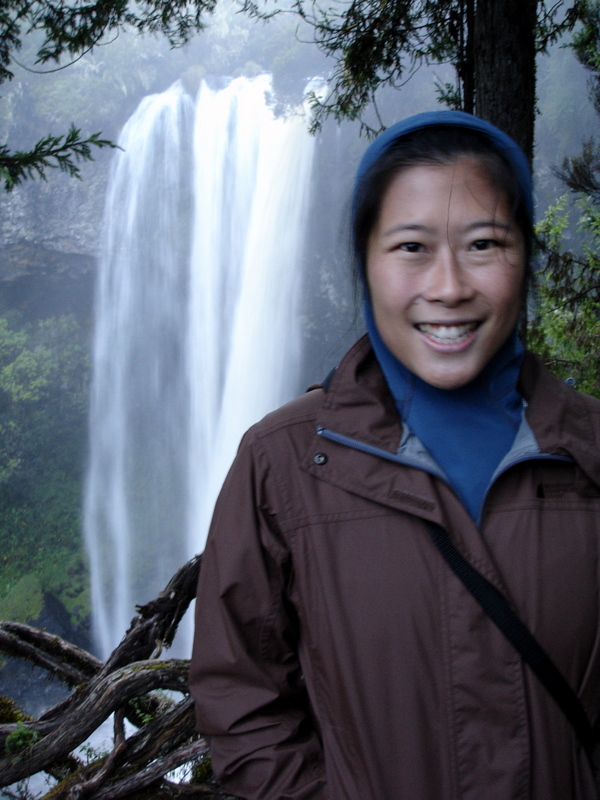 After setting up camp we hit the road and found several buffalo, duikers (a type of antelope), and reedbuck. We decided that we had just enough time to visit the nearby Chania waterfalls. The falls were absolutely gorgeous, and the recent rains meant that they were at full-flow: an incredible sight.
Just outside camp on our way back we stumbled upon another bonus: an encounter with a rare black (melanistic) serval cat. They are essentially like a small black panther, and seldom encountered in Kenya .
The wet conditions meant that making a fire was next to impossible, but nothing that a little gasoline couldn't rectify. We enjoyed shish-kabobs and hotdogs, and dined amongst several "eyes" watching around the campfire. The eyes belonged to buffalo and antelope (they light up with a greenish tint when illuminated with a flashlight), but also what we think were several hyenas (with a nice reddish-tint characteristic of predatory animals). This wasn't too much of a concern as long as the fire was going and we didn't stray to far from camp! That night we heard the barks of wild-dogs far off in the distance, and slept fairly well in our cozy little tent.
DAY 2 - Journey to the salient (or Decent from the Misty Mountains to the Shire)
We awoke to frigid conditions and quickly warmed ourselves with still-steaming coffee from our thermos at around 6:30am. We broke camp quite
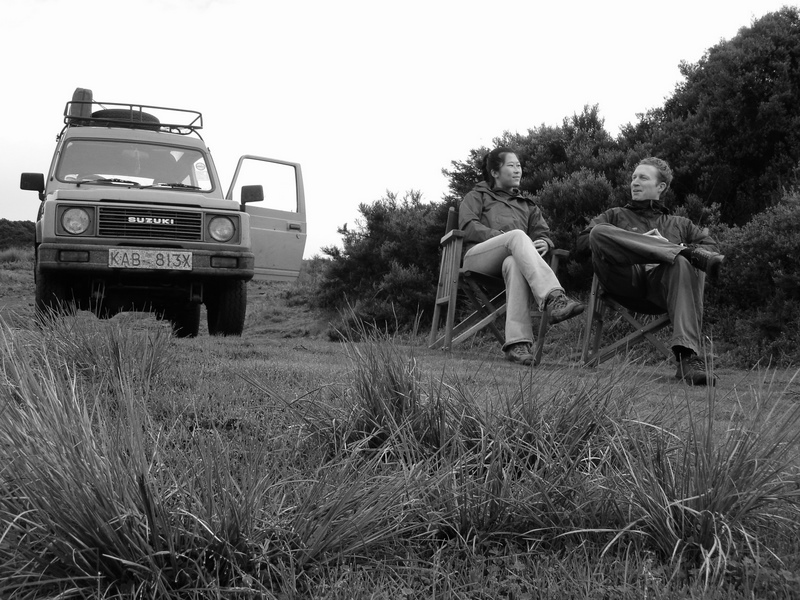 quickly as we were eager to start the day off and begin our quest for elephant. We returned to Chania falls for a quick breakfast (which was on the way) consisting of fruit salad, and also samosas warmed on the old engine block. Our goal for the day was to travel the 15 km or so it would take to get to the lowland area of the park known as the salient. It was there that we would have our greatest chance of finding elephants, in addition to other animals such as bongo antelope, wild bush pig, and rhinoceros. Our map that we had purchased at the entrance to the park, and which the warden had assured us was the best map available for the park, indicated that there were two roads leading to the salient. The southern route led to a large red mark on the map labeled "blockade" and then led outside of the park. The northern route was a bit longer, but ultimately led into the salient. Judging by the contour lines it appeared to be a beautiful mountain pass. When we got to the fork which separated the two we headed north and looked forward to avoiding having to exit the park and then re-entering it at another entry point, as the southern route would have required.
The northern route proved to be gorgeous for the first 7 km. It didn't look like it had been used for a quite some time, but we hadn't seen a single other vehicle since we had entered the park so this
 did not come as any sort of surprise. We winded up grassy hills, traversed past alpine lakes, and descended through dense bamboo forests. Occasionally the lakes which were flooded would run into the road, but they were easily bypassed and we thought nothing of it. Just before making our decent into the salient, and with only about 5 km to go, the conditions became slightly more muddy. We were in a small valley which acted as a sink, collecting rainwater and turning dirt to thick mud.
"Momentum" I told Jessica "is key in these sorts of conditions!" as we blasted across large mud ponds, and pools of water almost 2 feet deep. Battlecat handled incredibly well, and we took comfort that if we did get stuck our faithful 4x4 was so small that it would only take one of us to push it out. As we rounded a corner I saw a small hill, about 20 metres long, that looked quite slightly more muddy than any we had encountered so far. I stomped the accelerator to the floor and pondered the best path to take up the hill. About half way up the tires started spinning, and our progress came to a stand still. I reversed back down the hill, got a good running start, and floored it once again. We made it about one foot higher than our first attempt. Several more attempts got us to roughly the same spot and we found ourselves having to decide if we should turn around and backtrack to the southern route or jump into the mud and muscle Battlecat up the final 10 meters.
We decided that we had come too far to turn tail and retreat. There were elephants to see, and some muddy hill wasn't going to interfere with our plans! How hard would it be to get up this slope of oozing 6-inch mud? Sure, we'd get a little dirty and sweaty. but surely it wouldn't take too long?
Oh, how wrong we were....
The muddy hill of doom
We started off with simple pushing. Unfortunately Jessica had never driven the 4x4 before (by her own decision!) and wasn't feeling comfortable maneuvering Battlecat out of the dirty mess. Even still we gave it a try with her driving, but the correct combination and
 timing of the parking break, clutch, and gas pedal wasn't happening. She decided it was best if she pushed. I wasn't comfortable with her doing all the hard work, but we both decided that it wouldn't take too long, and I was better at getting old Battlecat out of the mud. The elephants were waiting.
We quickly realized that we were getting nowhere simply pushing, rocking, and trying to get a bite by rotating the steering wheel to the two extremes. We would need some sort of traction. I abandoned my "tread lightly" mentality, pulled out my leatherman, and quickly proceeded to hack down all the surrounding folliage in order to create a path of traction. It was slow going. We tried using rocks. It was even slower going. We went back to sticks & leaves.
At this point we were committed. There was no way in hell we would give up after all this work, and we were going to get up this $%&*#@& hill if it was going to take us till sundown!
And so it went. We placed sticks on all sides of the tires, pushed with all our might, and the car would move another foot or so before getting stuck again. Using this technique we moved at a rate of 2 feet every 10 minutes. The top of the hill got closer and closer, and our resolve became greater and greater. Finally, just as the steep part of the slope started to decrease in grade I could feel the car gain extra horizontal traction, and Jessica's push allowed me to roar to the top of the hill. A scream of joy escaped my lips, and I hopped out at the top to greet Jessica as she made her way to the top of the hill. She was crying with joy, and we promised to ourselves that we would never attempt this part of the Aberdares during the rainy season again. It had taken us 2 1/2 hours to reach the top, and we were ready to continue on.
Back on the road
According to our super-accurate park-purchased map the last 5 km of the northern route we were taking led to the northern border of the park where there is an exit gate and a road that parallels the park b
 order before decending into the salient: our destination for the elephants. After the muddy hill debacle we were feeling pretty good about ourselves, and that we could get out of almost anything mother nature threw at us. Sure the day was pretty much spent (it was almost 4pm), but we had survived a difficult situation and we would have some great stories for years down the road. Our smiles faded as we approached the nothern gate only to discover that the road leading into the salient was closed (and had been for some time) and our only option was to exit the park at the gate, and then drive around to another entrance to the east.
We were not happy.
We drove to the gate to find that the park ranger guarding it was looking at us with quite dumbfounded expression. We stopped to say hi, and looking at our little 4x4 all he could say was "you came though in that?!". There was only one route we could have taken to get there, and we told the ranger that indeed it had been a tricky route, we had got stuck once, but that our little Battlecat was a strong car and we were quite proud of it. The ranger couldn't believe it. "You're the first car I've seen since a big Land Rover made it through about a month ago" he said.
The pride that we felt after finding out that we had just accomplished quite the off-road adventure -- even by Kenyan standards -- was slightly diminished by the fact that the route we'd have to take to get back inside the park was long and bumpy. We seriously contemplated giving up and just heading back to Nairobi, but we soon realized that we couldn't let the Aberdares defeat us! We still hadn't seen an elephant yet, and we refused to go home with our tail between our legs.
By the time we got to the next entrance to the park it was almost 6pm
 and the sun would soon go down. Our campsite wasn't too far away, and we barreled past huge wild bushpigs and numerous antelope as we raced the suns decent to the horizon. We arrived to find a much nicer campsite than where we had stayed the previous night. It was called 'Bongo Campsite' (after the rare 'Bongo' antelope) and is aptly named, for it is an antelope grazing pasture. It had nice short grass, and antelopes all over. We set up the tent and had a fire going in record time.
There were no red-tinted eyes glowing at us around the campfire that night, just green ones indicating antelope and buffalo. Because of this, and also the nice soft ground, we slept very well.
DAY 3 - The Quest for Elephant Continues...
We awoke in the morning to find sunny skies and warm conditions: the exact opposite of the previous morning. We reasoned that since the conditions were in our favour, today would certainly
 be the day that we would find our elephants. To further lift our spirits, a black rhinoceros (rare in these parts compared with the white rhinoceros) trotted out the woods not 30 meters from us, turned the corner, and headed hack into some bushes a little further down the way as we packed the tent up. It was a good sign indeed.
The roads in the salient criss-cross the park in an east-to-west fashion and we decided to make use of this feature by doing a 'sweep' of the park in order to maximize our chance of finding elephant. We would start at the southern end of the park where we were camping and criss-cross our way until we made it to the northern end. In this way we would transect the park about 6 times from east to west.
As mentioned before, the Aberdares is much different than the classical savannah parks of Kenya. It is quite hilly and densely vegetated.
 The first road we found ourselves on followed a beautiful ridge which paralleled a river. It was absolutely gorgeous and gave us a great vantage point to spot potential elephants. Mt Kenya broke through the clouds for a short period of time. We set off after breakfast feeling rejuvinated, inspired, and ready to spot some elephants.
As we worked our way from south to north we spotted numerous baboons, antelopes, buffalo, and bush pigs. We passed by gorgeous watering holes full of animals that we thought would be perfect drinking spots for elephants. But alas there were none to be seen.
We were also looking for other signs of elephant to assist our search. We had so far come across lots of elephant dropping, but unfortunately none of them were fresh. It wasn't until we reached the northernmost road in the park, the only road we hadn't checked yet, that we found fresh elephant tracks. The forest is dense in this part of the salient, but we followed these tracks with determination. They followed the road for some while, and then trailed into the forest. The forest was so thick we had no chance of spotting them, so we continued down the road in hopes that they might have emerged in order to cross the road again. Sure enough we picked up some more fresh tracks, but again they trailed into the forest, this time on the other side of the road. We cut the engine to attempt to hear any elephant sounds coming from the forest. Nothing.
Unfortunately it was getting to about midday by this point, and about time that we should be leaving in order to reach Nairobi at a good hour. Our quest for elephant was unsuccessful. We checked at the main gate with the rangers to inquire about elephant sightings so far that day. "They've been hiding in the forest recently" they told us. That would explain our difficulty in finding them.
All was not lost however. We had had a great adventure, seen numerous wildlife, and experienced a part of Kenya that is seldomly visited by western tourists. We felt stronger after our bout with the mud hill, and we had learned way more about safari in Africa than we could have ever expected. We accepted that it simply wasn't our time for spotting elephant, departed the gate, and headed south for Nairobi.
Monday, December 04, 2006
Update on our adopted elephant
"Little Galdessa made the Keepers very happy today, because he has been running to his blanket to take his milk eagerly, previously having been a very reluctant feeder because his face was so sore."
And a recent shot:

It turns out we mis-sexed our baby! She is actually a he, and was named a rather feminine name after the camp at which he was found. On the website there is all sorts of information and pictures about where they found Galdessa, the rescue, and how he is currently doing. Click on the picture of Galdessa being transfered to Nairobi below for a direct link:

Friday, December 01, 2006
Shots from the Aberdares adventure!

Story to come...
Update on Galdessa (our adopted elephant):
Our friend who adopted an elephant for us as a gift visited the rehabilitation center while we were in the Aberdares, and she is happy to report that Galdessa is doing excellent. She is now used to the keepers so she can join the other babies out of the stable. We'll be visiting her soon and getting some photos of her up on the blog.
Saturday, November 25, 2006
New photos

Wednesday, November 22, 2006
We are proud new parents!

And here is a shot of our new bundle of joy:
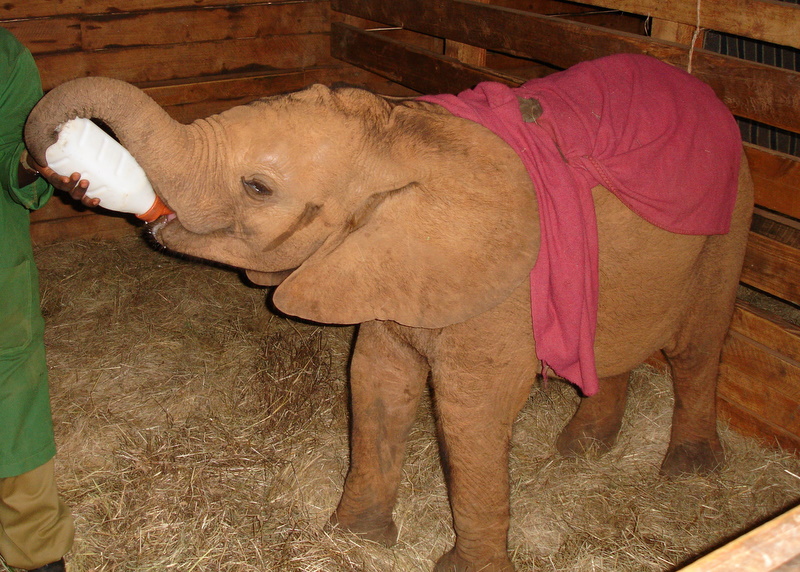

Our good friend Emma, who is from Ireland and doing some post-doc work here at ILRI, adopted an orphaned elephant at the David Sheldrick Wildlife Trust here in Nairobi. It's a center where they rehabilitate baby elephants that have been orphaned in the wild. Anyhow, she invited us to visit her elephant tonight (foster parents get to come in at a special time and get to see the elephants up close and personal). As a gift she ended up adopting one for us too, and we now find ourselves parents of a baby elephant!
Her name is Galdessa, and actually the shot above isn't her, but it is one in an adjacent pen which is about 15months old or so. Ours is only 3 months so it is much smaller! It was airlifted just today from Tsavo National Park where it was found in a generator shed by one of the park staff. Since it has only arrived we didn't spend too much time with it because it is still a little spooked from the trauma of the past 24 hours. We'll have some shots of her when we go back to check on her progress in about a week or so.
As her "foster parents" we get continuous email updates about her progress. Also we get the special privilege of coming in after viewing hours and actually being able to pet her and generally spend some time getting to know her (something which you can't do during regular hours!). Anyhow, we look forward to blogging about her progress. As I mentioned, she seems to have suffered some trauma over the past while, so we hope that she settles into her new surroundings.
The link below is for the project's website, and it has some great information:

Sunday, November 12, 2006
Back from Kapiti
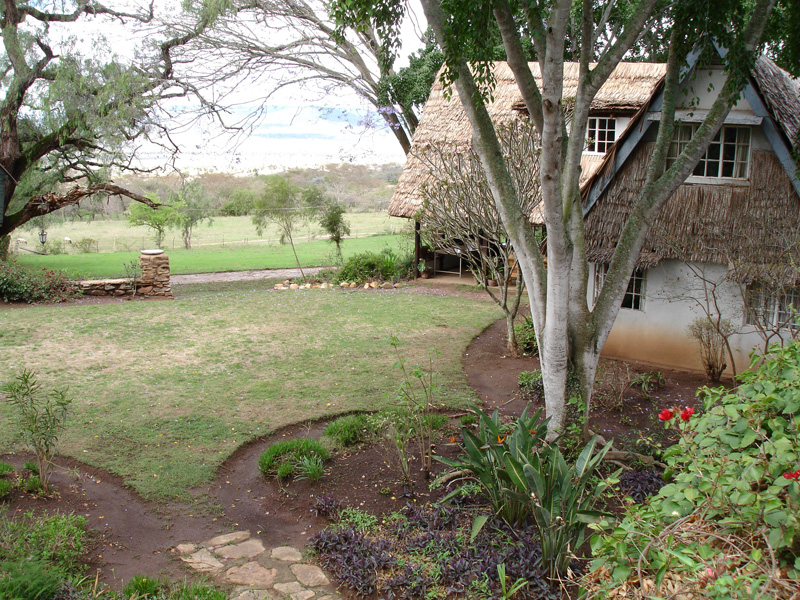
We stayed at an ILRI-owned ranch for the weekend called 'Kapiti'. It's a fantastic old colonial house with several wings, and secret tunnels connecting them.
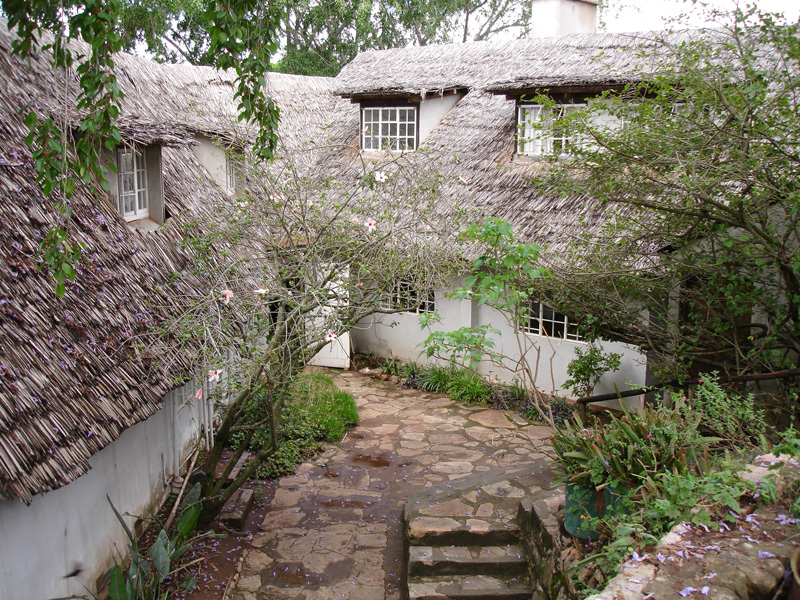
The area surrounding has some great wildlife, and we should have some video up soon. We had a whole lot of rain during the night, so this mornings game drive was a muddy one and Battlecat is filthy!

The drive yesterday was gorgeous. We ascended a small peak on a nice little dirt road in order to spot game down below. We headed down towards where it looked like the most animals were, and ended up having tea amongst a group of 38 giraffes! We also saw lots of zebra, gazelle, hartebeest, jackal, wildebeest, and warthog. It was a great trip, and we look forward to returning since ILRI staff get to stay there at a very reasonable rate.
We should hopefully have some video posted early this week...
Thursday, November 09, 2006
Two adventures for the weekend!
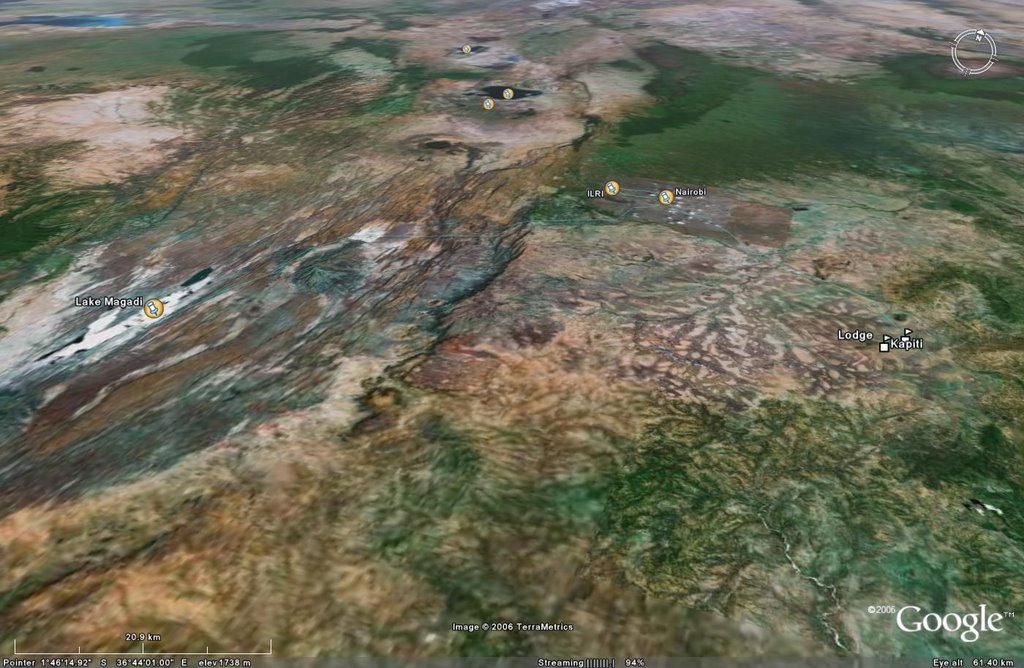
Lake Magadi:
During the dry season, Lake Magadi is 80% covered by soda and is well known for its wading birds, including flamingos. It is a saline, alkaline lake, approximately 100 square kilometers in size, which is made up of a dense sodium carbonate brine. In places, the salt is up to 40 m thick. The lake is recharged mainly by saline hot springs (up to about 80°C), and there is a single species of fish, a cichlid called Alcolapia grahami, that inhabits the hot, highly alkaline waters of this lake basin. The lake is featured in the film The Constant Gardener, although in the film the shots are supposed to be at Lake Turkana.
Kapiti:
We don't know too much about Kapiti, other than the fact that it's a ranch that ILRI owns and there's lots of animals there. In fact, some lions apparently got into the sheep pens not too long ago and killed quite a few of them! It's not too far away from Nairobi, and the road is good getting there. We were invited to come by some friends here at ILRI, and we couldn't pass it up!
Pictures/video to come!!!
update: We still managed to have the afternoon off today, so instead of Magadi we got some supplies at the local market. One new piece of kit that we picked up is a spotlight for our 4x4 (which is henceforth named 'Battlecat'). One of the really cool things to do when on safari is not just day trips, but also night trips because it's a whole different game at nighttime. You have to have a spotlight though, cause that's how you find animals and also identify them from afar (ie predators eyes tend to reflect a bit different colour than grazers). Anyway, where we're going tomorrow is apparently very good for night trips, so we're excited to have the new gear. It's also probably our best chance of finding lions since they're often hard to spot during the daytime cause they're hiding out from the heat. Hopefully we'll have some good video ready for posting sometime next week (I've now figured out a way to get footage from our real video camera online instead of our digital camera, so the quality should be much better!).
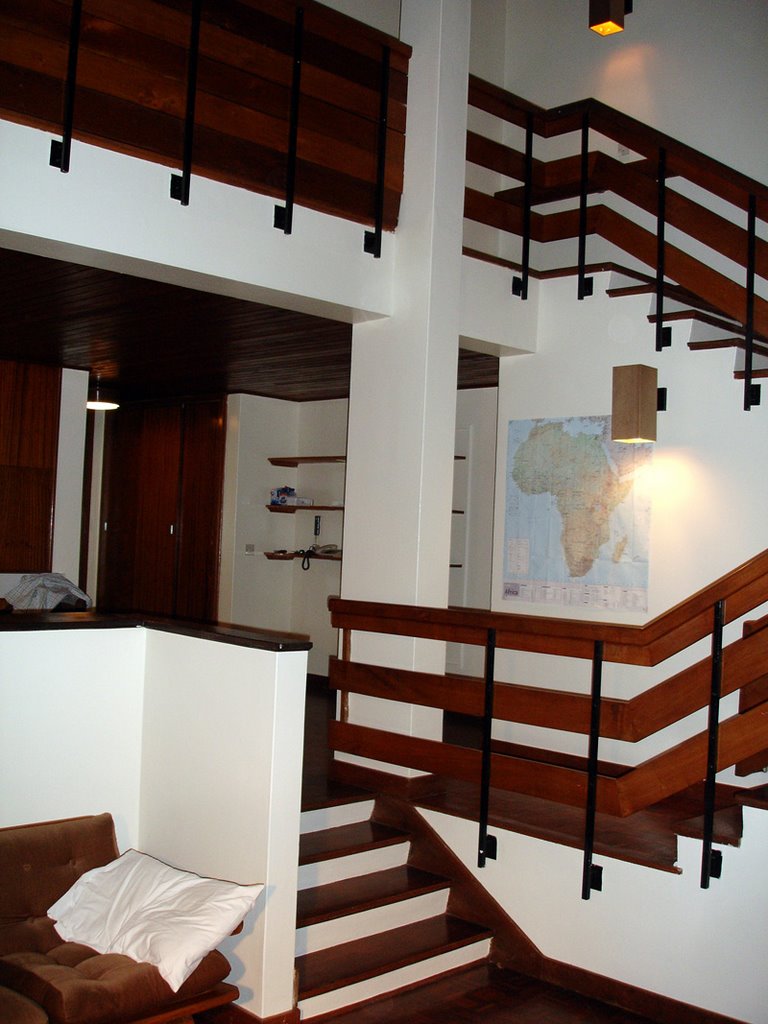
Our new house:
Also, here are just a few shots of our new place for those interested:
This is the view coming down the stairs into the living room & dining room:

And this looking across the dining room into the kitchen:
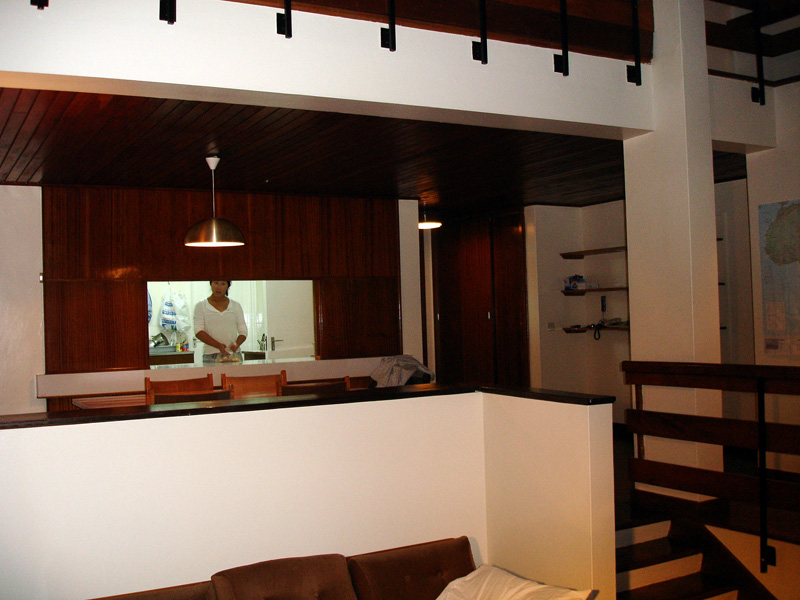
And this is looking up the stairs:
Sunday, October 29, 2006
Photos from Lake Nakuru National Park
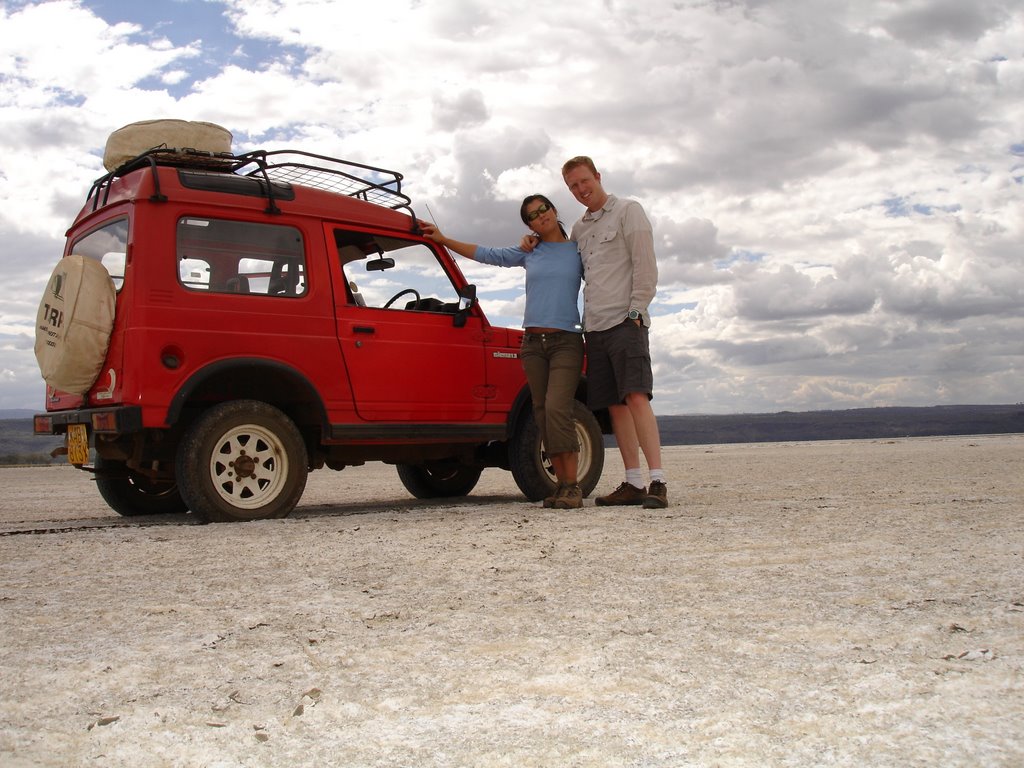 We've returned from our maiden voyage in our new 4x4, and the new steed definitely did well. The last 30 km or so of the road getting to Nakuru was bumpy to say the least, and the Suzuki performed great. The park itself was incredible, and there were lots and lots of animals to be seen. Some of the new species that we saw: White Rhino, Waterbuck, Ostrich, Spotted Hyena, and Vervet Monkeys.
Right now I'm pretty tired from the drive back, and just getting caught up on some work but we'll post some stories tomorrow. Video in a few days hopefully!
Click the link below to go directly to the album:

Also, I put a few links in the side bar on the right (you might need to refresh your browser) for those of you who wanted to know more about the work that we are doing here in Nairobi!
Saturday, October 21, 2006

Wednesday, October 11, 2006
Things are going well!
 The campus where we are living is incredible; it is an oasis of manicured lawns, incredible flora, huge pastures (for the cows), and all the amenities (restaurant, bar, squash, tennis, pool, etc). Not what we were expecting! The odd bit is that we are absolutely surrounded by some of the more extreme shanty towns that I've encountered in my travels. It's a strange dichotomy. The campus is surrounded by large fences, and there are guards everywhere. Very strange, yet right now I'm sitting in my room (with internet hookup) with the patio door wide open, there's some people having a picnic on our front lawn, and I have to say that it is nice to feel safe.
“Farm animals are an ancient, vital and renewable natural resource. Throughout the developing world, they are means for hundreds of millions of people to escape absolute poverty. Livestock in developing countries contribute up to 80 percent of agricultural GDP; some 600 million rural poor people rely to a significant extent on livestock for their livelihoods.”
ILRI has five themes – or areas of focus – in order to address the severe constraints to livestock production in poor countries. My position here fits under theme 4: Biotechnology.
A bit of background: In  ormation about several trypanosome antigens which may potentially be used to devise diagnostic tests for African sleeping sickness.
The work that I will be doing here is somewhat related, but more to do with the host-pathogen interaction that occurs during trypanosomal infection. In addition there is more of a focus on what is occurring on the genetic level. I’ll also be looking primarily at the animal form of trypanosomiasis, which accounts for why I’m at a livestock institute!
The first project that I’ve been assigned to is an investigation into the role of endotoxins in pathology following T. congolense infection in mice and cattle. In plain English, does the infected host (mice or cow) have bacterial toxins in its blood following trypanosome infection, and what effect does this have on the host-pathogen interaction and the infection itself?
Well, I’ve probably lost about 90% of readers by now, so I think I’ll move away from the science and back to how things are going with Jess & I!
The setup here is very good for meeting lots of people -- locals, and visiting scientists alike -- since everything here is self-contained (i.e. a lot of the people live on the campus so it almost has a 'resort' feel to it). The scientists are from all over; I haven't met two from the same country yet. The lab I work in has about 8 people, headed up by an immunogeneticist out of the
Since we have arrived here, we have had quite a few happy surprises. First was that our accommodations exceeded our expectations greatly, and that their cost was being covered by the project that I’m working for. Second, was that instead of just being a lowly intern, I will actually be under contract with ILRI as a “visiting scientist”, which I would assume entails greater responsibilities and should be even better experience than I anticipated. Third, after meeting one of the evolutionary biologists here it appears that Jessica may have a job working in the parisitology lab as well (I’ll let her tell you about it – she had her first day today). Above all, we have been overwhelmed with the warmth and friendliness of everyone we have met – especially the locals that we have encountered on campus, and also in our ventures into
Anyway, our goal (other than brushing up on a lot of biochemistry!) for the next week is to get a car. I will be posting about it once we find our new steed. I’m hoping for a
I still haven't managed to post video yet unfortunately. The connection here is somewhat faster than dial-up, but not as fast as broadband. My video uploads will get to 60% and then just stall out. Looking into other ways of tranferring files, and hopefully with have something sussed out soon!

