Showing posts with label matt. Show all posts

Tuesday, April 03, 2007

Africa 2006-2007: Matt's Final Thoughts

This is adapted from an article I wrote for the newsletter of the project that I'm working for, so it's not really in my usual voice but it summarizes my thoughts, and was easy to copy and paste into a post (and perhaps illustrates the reasons I did poorly in English class):

When planning this working-trip back in Canada, the choice of Nairobi was at the top of the list. I had spent two months in Namibia and Botswana in 2003, and had been looking to get to back to the continent ever since. Jessica and I first and foremost wanted to get some wet-lab experience in Africa, and we knew that we needed to be in a major center for research in order to maximize our job prospects. In Kenya we would have no major difficulties with a language barrier, and east Africa would offer us some of the best opportunities for wildlife viewing in the world. The recent travel advisories issued by the Canadian government warning against travel to Nairobi – known to many travelers as “Nairobbery” – were somewhat concerning, but as with many big cities we knew it was just a matter of avoiding specific areas of the city at specific times. Once we got over the mental hurdle of committing to Nairobi, ILRI was a top choice for me since I was already involved with research on cell surface antigens of African trypanosomes.

Upon arriving at ILRI we were blown away at how nice the campus was, and how good the lab facilities were. Looking at the aerial view of the campus on Google Earth back in Canada I could see that it was beautiful, but the detail wasn’t quite sufficient to resolve the tennis courts, pool, volleyball court, rock climbing wall, and the other luxurious amenities!

At ILRI I was involved with the Shockmouse, Paramouse, Bigmouse, and C57lite projects. Not only did the projects have cool names, but through them I learned a great deal and got experience that I never could have hoped for back home. I found that one of the greatest things about working on trypanotolerance whilst in Africa is the heightened feeling of relevance and urgency for the work that we’re doing. Jessica and I had many opportunities to travel through the rural regions of Kenya in the beat-up ‘92 Suzuki 4x4 that we bought shortly after arrival in Nairobi, where it was easy to see firsthand just how vital livestock is to the people here.

Perhaps one of the greatest aspects of working here at ILRI was the people that I got to work and interact with every day. I was surprised – and very happy – to find that at the bench I was working primarily with local Kenyans. There’s no better to way to learn about a culture than to interact with the locals on a regular basis; you learn and experience things that most tourists visiting a country will never have the chance to appreciate. On top of the rich experience with locals, there are visiting scientists from all around the globe working at the facility, which makes for an incredibly diverse experience. At any given dinner out with friends there are often up to ten countries represented, usually from up to five different continents. This diversity is something which I particularly enjoyed while at ILRI, and one of the things I’ll miss the most when I return to Canada.

Life in Nairobi has been not without its drawbacks. In the time that we’ve been here two colleagues have had their vehicles carjacked or stolen by thugs, we’ve been bribed twice by local police, and an astounding number of western tourists have been killed in either car accidents or carjackings no more than 15 km away. Night time excursions for dinner or entertainment have to be weighed against the probability of carjackings, which spike every now and again, and are often made in convoy for safety reasons. These facts produce a certain amount of unease when outside the compound, which for a new visitor can take a while to get used to.

Outside of Nairobi things become much safer – aside from the highways – and I would say that 99% percent of the Kenya’s natural treasures lie outside of its capital city. During our six months here we’ve been on self-guided safaris to several of Kenya’s national parks, and we’ve enjoyed them tremendously. We’ve had incredible encounters with white rhinos along the shores of Lake Nakuru, we’ve marveled at massive groups of elephants in the shadow of Kilimanjaro in Amboseli national park, seen the rare black serval cat in the high plateau of the Aberdares, and watched the sunset on the gorge of Hell’s Gate national park. We’ve also made trips down to Tanzania and to Madagascar; both of which were incredible experiences.

Overall, the experience I’ve had in Kenya these six months has certainly exceeded my expectations, both professionally and personally. There are some unfortunate truths about life in Nairobi, but the cons are made up for by the pros. I’ve met incredible people, seen incredible wildlife and geography, and have no doubt that I will return one day soon.

-Matt Pope

Saturday, January 06, 2007

Happy New Years!

Christmas & New Years were good to us, and now we're back to work in what we're calling "Phase 3" of our African trip. We will only be here in Nairobi for another two months or so, and then we'll be spending a month or so traveling before returning to Canada somewhere around mid-April.

The holidays were great, and we had good times with Jenn & Paul on our return to the Aberdares, our trip to Tanzania, and lounging around the house playing cards and drinking holiday concoctions.

In late December we were somewhat annoyed to discover that Housing had made a mistake here at ILRI which would necessitate our moving from the house back into the hostel. We put up quite a fight, but in the end nothing could be done. The guy in charge of Housing felt pretty bad about the whole affair, and ended up hooking us up with the one of the nicest rooms in the hostel. It is much nicer than our previous room here, and in addition to having our own balcony and a queen size bed (we used to have to push two singles together), the room has a killer view:

It's much brighter than our house was too, so all in all things are pretty good in our new abode.

Things at work for me are going quite well. Without nixing myself for talking about it too much, a team I'm part of has just advanced to the final stage of a competition for a fairly significant governmental grant. We find out in mid-Febuary if we get it, and if we do it'll have a huge impact on what I will be up to for the next 3 years. I'm crossing my fingers...

In other news, we have finally decided where we will be going for our end-of-trip trip (that's not a typo). Here is a big clue:


Can you guess?? Post your answer in the comments if you know...

Saturday, November 25, 2006

Navigation here just got a whole lot easier!

Navigation here in East Africa just got a whole lot easier because Google has just released a new overlay in Google Earth called Tracks4Africa. I was so excited I had to blog about it! Apparently the data layer comes from 6 years of work from the fine people at Tracks4Africa, a non-profit organization dedicated to the accurate mapping of off the road tracks and destination in Africa.

Here is an example of what I've been using to plot out routes on our GPS (here, our recent trip to Hells Gate National Park, click to enlarge):


And now adding the Tracks4Africa overlay in Google earth, you get the following (click to enlarge):


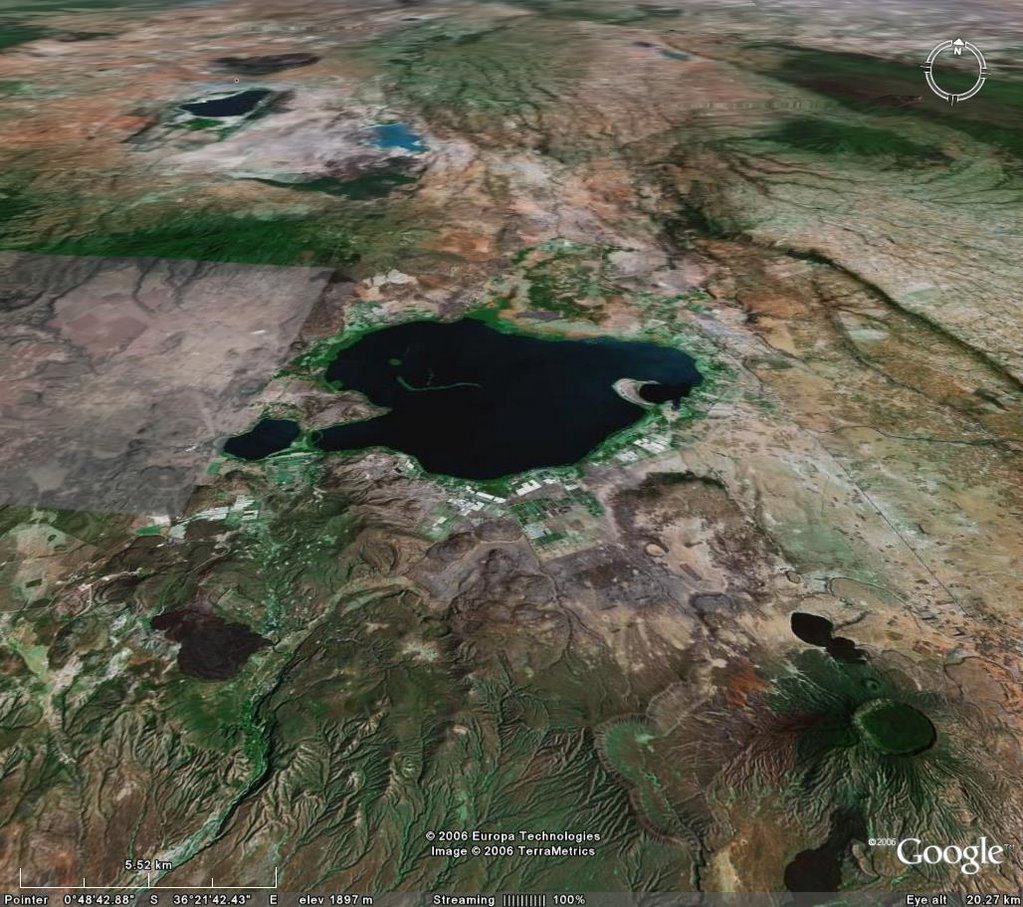
It's not just the main roads that lead to the park which are overlaid, but even the secondary, off-road, and hiking tracks! On top of that there are point of interest, national park boundaries, lodges, gas stations..... it's incredible. In the picture above, Hells Gate is at the bottom left, Lake Nakuru is on the top left, and our next destination, Aberdares National Park, is just barely visible on the right.

More on Google earth here.
And more on Tracks4Africa here.

Monday, November 06, 2006

Moving on up...

Well, we have no adventures to report on from the weekend unfortunately. We're thinking of getting away for a 3 day trip this weekend down towards the Tanzanian border however, so we'll keep you posted!

Saturday was another big day for me at work because I had to "harvest" my remaining tryp-infected mice in my current project which is now almost coming to a close. The project isn't quite complete, but we are at a bit of a roadblock until some additional reagents arrive from the UK at the end of the month. I'm now moving on to two new and very interesting projects. One involves looking at a correlation that has been found between trypanosome-resistant mice and their physical size. The other involves looking at several strains of congenic (mice which genetically only differ at one genetic locus) mice and analyzing their response to trypanosome-infection. Both projects involve gene expression and immunology -- which are my two primary fields of interest -- and so I'm quite excited to get started on them.

In other news, we have been 'upgraded' here at ILRI with regards to our accommodations! We're moving from our hostel room into one of the staff houses tomorrow, and we're looking forward to having lots more space (especially in the kitchen!). We'll still be on campus, and the house is actually only about 200 meters from where we're currently staying. It's a two bedroom house, so that means that anyone coming to visit gets their own room! That means you Jenn & Paul, Chris, and Chelsea (and whoever else might be coming to Nairobi)! There's a garden area in the back, a fireplace, large living room with cathedral ceiling, dining room, and a much more functional kitchen than what we're currently using.

I also spent the weekend getting more familiar with the mechanics of our new 4x4. I have to say that I'm pretty happy with the purchase so far (knock on wood), and I'm excited to get it equipped for our planned longer-term adventures. So far we already have two spare tires, tools, and an extra jack. I have to say that the GPS we brought has already got us out of a few tricky navigational situations, so it too is indispensable. I'm currently sizing up some 20 L jerry cans which will mount on either side of the spare tire on the roof rack, and we will also need a fire extinguisher (not just for fires, but lions too!) and jumper cables. The goal that we still have in mind is to make it to a park in southern Tanzania called 'Ruaha'. It is supposed to be incredible, but quite a bit more remote than some of the parks in the north of Tanzania. Still lots more research to do, but we hope it will be a go.

That's about it for now!

Wednesday, October 11, 2006

Things are going well!

Jess & I are now feeling acclimatized to our new surroundings, and things here are going great. The campus where we are living is incredible; it is an oasis of manicured lawns, incredible flora, huge pastures (for the cows), and all the amenities (restaurant, bar, squash, tennis, pool, etc). Not what we were expecting! The odd bit is that we are absolutely surrounded by some of the more extreme shanty towns that I've encountered in my travels. It's a strange dichotomy. The campus is surrounded by large fences, and there are guards everywhere. Very strange, yet right now I'm sitting in my room (with internet hookup) with the patio door wide open, there's some people having a picnic on our front lawn, and I have to say that it is nice to feel safe.

I think I’ll use this opportunity to mention a little bit about the group that I’m working for here in Nairobi. ILRI (the International Livestock Research Institute) is a non-governmental organization which describes itself as working at “the crossroads of livestock and poverty.” Its mission is to “bring high-quality science and capacity-building to bear on poverty reduction and sustainable development for poor livestock keepers and their communities”. The group works in Africa, Asia and Latin America and the Caribbean; and has partnerships and alliances with other organizations, national and international, in livestock research, training and information. Why livestock research for the poor? From the ILRI website:

“Farm animals are an ancient, vital and renewable natural resource. Throughout the developing world, they are means for hundreds of millions of people to escape absolute poverty. Livestock in developing countries contribute up to 80 percent of agricultural GDP; some 600 million rural poor people rely to a significant extent on livestock for their livelihoods.”

ILRI has five themes – or areas of focus – in order to address the severe constraints to livestock production in poor countries. My position here fits under theme 4: Biotechnology.

A bit of background: In Victoria I was spending one or two days a week in the lab of Dr. Terry Pearson. Terry’s lab does work on African trypanosomes, which are parasites that can cause trypanosomiasis. Trypanosomiasis has two main forms: 1) human trypanosomiasis (African sleeping sickness) and 2) animal trypanosomiasis (often called ‘nagana’ in vertebrate animals). The primary focus in Terry’s lab is on the cell surface molecules of trypanosomes, with a principal goal of providing information about several trypanosome antigens which may potentially be used to devise diagnostic tests for African sleeping sickness.

The work that I will be doing here is somewhat related, but more to do with the host-pathogen interaction that occurs during trypanosomal infection. In addition there is more of a focus on what is occurring on the genetic level. I’ll also be looking primarily at the animal form of trypanosomiasis, which accounts for why I’m at a livestock institute!

The first project that I’ve been assigned to is an investigation into the role of endotoxins in pathology following T. congolense infection in mice and cattle. In plain English, does the infected host (mice or cow) have bacterial toxins in its blood following trypanosome infection, and what effect does this have on the host-pathogen interaction and the infection itself?

Well, I’ve probably lost about 90% of readers by now, so I think I’ll move away from the science and back to how things are going with Jess & I!

The setup here is very good for meeting lots of people -- locals, and visiting scientists alike -- since everything here is self-contained (i.e. a lot of the people live on the campus so it almost has a 'resort' feel to it). The scientists are from all over; I haven't met two from the same country yet. The lab I work in has about 8 people, headed up by an immunogeneticist out of the University of Liverpool.

Since we have arrived here, we have had quite a few happy surprises. First was that our accommodations exceeded our expectations greatly, and that their cost was being covered by the project that I’m working for. Second, was that instead of just being a lowly intern, I will actually be under contract with ILRI as a “visiting scientist”, which I would assume entails greater responsibilities and should be even better experience than I anticipated. Third, after meeting one of the evolutionary biologists here it appears that Jessica may have a job working in the parisitology lab as well (I’ll let her tell you about it – she had her first day today). Above all, we have been overwhelmed with the warmth and friendliness of everyone we have met – especially the locals that we have encountered on campus, and also in our ventures into Nairobi, and the surrounding area.

Did I mention the desk they gave me has a view of Mt. Kilimanjaro on a clear day?

Anyway, our goal (other than brushing up on a lot of biochemistry!) for the next week is to get a car. I will be posting about it once we find our new steed. I’m hoping for a Toyota or Mitsubishi 4x4, but our vehicle budget is not huge, and we may have to settle for something a little smaller here or older.

I still haven't managed to post video yet unfortunately. The connection here is somewhat faster than dial-up, but not as fast as broadband. My video uploads will get to 60% and then just stall out. Looking into other ways of tranferring files, and hopefully with have something sussed out soon!